Why Your New Mundelein Home's Furnace Won't Start on the First Chilly Morning
The Sudden Chill: When Your New Home's Furnace Refuses to Wake Up
You wake up, throw off the covers, and immediately realize something is wrong. The thermostat reads 62 degrees, the vents are completely silent, and figuring out exactly why your new Mundelein home's furnace won't start on the first chilly morning is suddenly the only thing on your mind. Moving into a new property is stressful enough without the added panic of a freezing house just as September early fall weather settles into the region. For many recent homebuyers, this sudden lack of heat triggers immediate anxiety about massive, unexpected repair bills right after closing on a house.
Before you let the panic set in, it is crucial to understand that a dormant heating system often just needs a minor adjustment rather than a major overhaul. You are standing at a decision point: do you immediately book an emergency diagnostic call, or do you run through a few safe, basic homeowner checks first? By taking a deep breath and systematically evaluating the most common points of failure, you can often resolve the issue yourself. If those basic checks do not work, you can then confidently reach out for professional HVAC services knowing you have eliminated the simple fixes.
The September Weather Whiplash and the 'New Homebuyer' Panic
A typical pattern we see in Mundelein residential areas involves recent homebuyers who moved in over the summer and are entirely unfamiliar with their home's heating quirks. The Chicagoland weather whiplash is distinct; HVAC systems often sit dormant in humid basements for four to five months before a sudden cold snap forces them into action. During the summer, previous owners or home inspectors frequently shut down specific systems, such as gas valves or dedicated power switches, to perform maintenance or simply to secure the home.
This creates a stark contrast between the heavy, continuous usage of cooling systems and the sudden, urgent need for heat. While you may have just finished dealing with late-summer AC fatigue and troubleshooting, transitioning to heating requires a different set of baseline checks. One new homeowner reached out during early fall when their furnace refused to turn on after purchasing the house. A technician arrived the next day, discovered a heavily clogged filter left over from summer, swapped it out, and got the system running perfectly—all without charging an emergency fee.
At Air Kings Heating And Cooling, our honest, transparent approach means we actively try to save customers an unnecessary emergency diagnostic fee by teaching them these baseline checks first. We want you to feel empowered in your new home, understanding that many of these early-season emergencies are resolved without a costly repair bill.
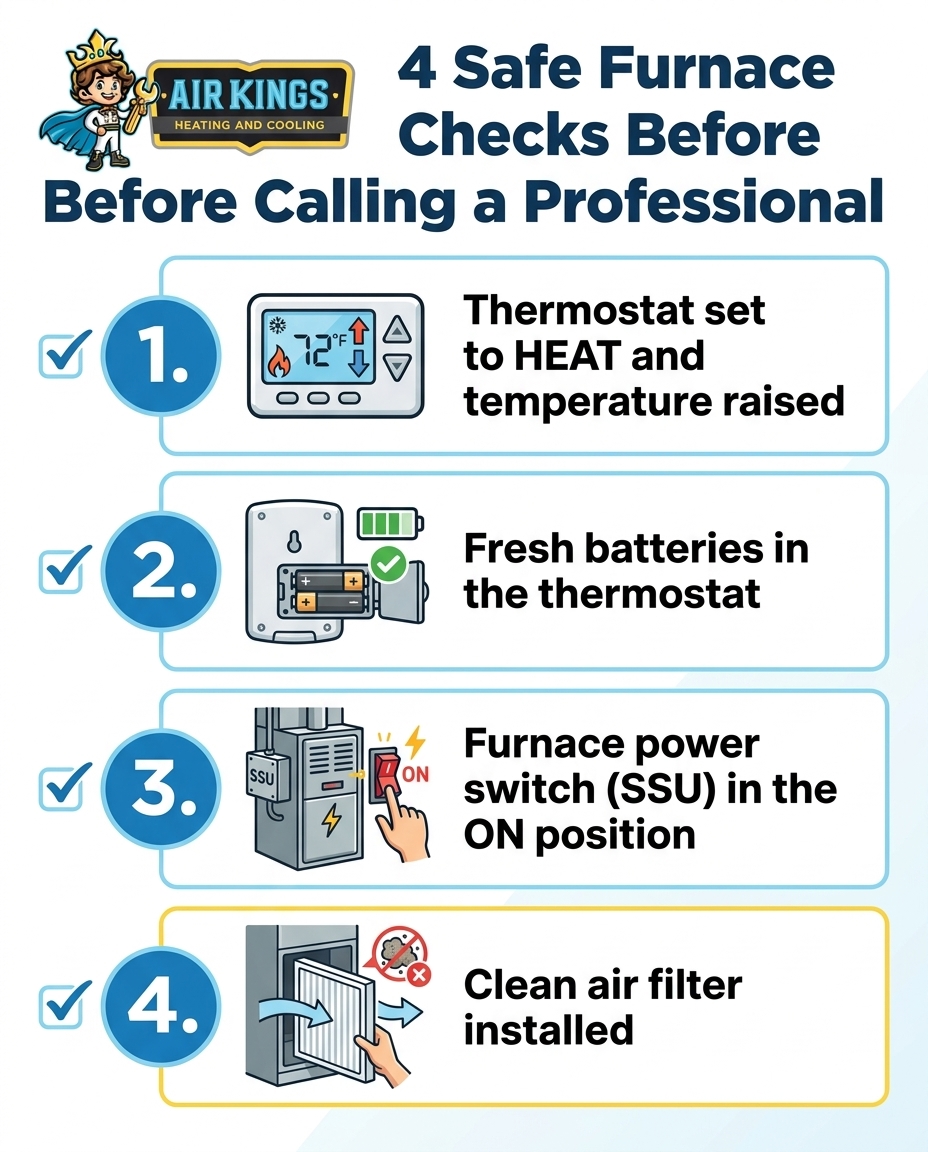
Step 1: Verifying Thermostat Settings and Power
The easiest and most common point of failure for any heating system is the device controlling it. When transitioning into September early fall, many homeowners simply forget to change their system's operating mode.
1. Switch from Cool to Heat: It sounds overly simple, but explicitly switching the thermostat from "Cool" or "Off" to "Heat" mode is a common oversight during the first cold morning. If the switch is still on "Cool," the furnace will never receive the signal to ignite.
2. Adjust the Temperature Differential: Advise setting the temperature at least 3 to 5 degrees higher than the current room temperature. This forces the system to recognize a significant temperature drop and call for heat immediately.
3. Wait for the Built-In Delay: Modern thermostats feature a built-in time delay (often 3 to 5 minutes) designed to protect the equipment from short-cycling. If you adjust the temperature and hear a click but nothing happens immediately, wait five full minutes before assuming the system is broken.
Replacing Batteries in Smart and Traditional Thermostats
A thermostat with dying batteries can cause erratic behavior, such as the system clicking without actually igniting the furnace. Even if the screen is still faintly visible, low voltage can prevent the internal relays from sending a strong enough signal to the furnace control board.
• Identify the low battery indicator: Look for a flashing battery icon or a "Low Batt" warning on digital screens. If the screen is completely blank, dead batteries are the most likely culprit.
• Remove the faceplate safely: Most modern thermostats simply pull straight off the wall plate with a gentle tug. Once removed, access the battery compartment on the back.
• Use fresh, high-quality batteries: Always use brand-new alkaline batteries (typically AA or AAA). Avoid mixing old and new batteries, as this can cause voltage inconsistencies.
• Blank digital screen — Potential Cause: Dead batteries or tripped breaker — Safe Homeowner Action: Replace batteries; check main electrical panel.
• Screen is on, but no heat — Potential Cause: System set to "Cool" or "Off" — Safe Homeowner Action: Switch to "Heat" and raise temperature 5 degrees.
• Thermostat clicks, furnace silent — Potential Cause: Time delay active or low voltage — Safe Homeowner Action: Wait 5 minutes; replace batteries if issue persists.
Step 2: Locating the Hidden Furnace Power Switch
One of the most highly specific, geographically relevant issues in Mundelein residential areas involves the accidental toggling of the furnace power switch. Building codes require furnaces to have a dedicated Service Switch Unit (SSU) installed within sight of the indoor equipment. This allows technicians to safely cut power to the unit without having to walk all the way back to the main electrical panel.
What is an SSU switch? In most basements or utility closets, this switch looks exactly like a standard light switch. It is usually mounted on the side of the furnace cabinet itself or on a wall stud immediately adjacent to the unit. Because it looks like a regular light switch, it frequently gets bumped or intentionally flipped off.
During the summer months, homeowners often organize their basements, clean around the utility area, or store holiday decorations. It is incredibly common for a shoulder, a moving box, or a broom handle to accidentally flip this switch to the "Off" position. Furthermore, previous homeowners sometimes turn this switch off intentionally in the spring, assuming it saves energy, and forget to tell the new buyers.
How to check it safely:
• Locate the switch: Walk down to your furnace and look for a standard toggle switch mounted on or near the metal cabinet.
• Verify the position: Ensure the toggle is flipped firmly into the "ON" position (usually UP).
• Do not rapid-cycle: Warn against rapidly flipping the switch on and off. Modern furnaces have complex computerized control boards. Rapidly cutting and restoring power can confuse the control board, potentially triggering a lockout mode that requires a professional reset. If the switch was off, flip it on once and wait a few minutes for the system to boot up.
Step 3: Checking the Main Circuit Breaker Panel
Many homeowners are surprised to learn that even gas furnaces require electricity to operate. While natural gas provides the actual heat, electricity is necessary to power the blower motor that pushes air through your vents, the control board that manages the system's logic, and the electronic igniter that lights the gas. If the power is interrupted, your gas furnace will remain completely dormant, even on a chilly September early fall morning.
Locating and identifying the breaker:
Guide yourself to your home's main electrical panel, which is typically located in the basement, garage, or a dedicated utility room. Open the metal door and look at the rows of switches. You are looking for a breaker labeled "Furnace," "HVAC," "Heating," or "Air Handler."
What does a tripped breaker look like?
Unlike a standard switch that is either fully ON or fully OFF, a tripped circuit breaker often rests in the middle position. It might look slightly out of alignment with the rest of the breakers in that row. Sometimes, the breaker will show a small red or orange indicator window when it has tripped.
Safe resetting procedures:
1. Locate the suspected tripped breaker.
2. Push the breaker switch firmly all the way to the "OFF" position. You should feel a distinct click. Do not try to push it directly from the middle to the "ON" position, as it will not reset properly.
3. Once it is fully in the "OFF" position, firmly snap it back to the "ON" position.
4. Return to your thermostat and see if the system initiates its startup sequence.
A critical warning: If you reset the breaker and it immediately trips again with a loud pop, stop immediately. This indicates a hard electrical short within the system. Repeatedly resetting a tripping breaker is a severe fire hazard and can cause permanent damage to your furnace's internal wiring.
Step 4: The Hidden Culprit of Clogged Air Filters
Airflow restrictions from heavy summer usage are a leading cause of furnace failures in the fall. Throughout the hot months, your air conditioner runs almost constantly, pulling massive amounts of household dust, pet dander, and airborne debris through the return vents. By the time fall arrives in Mundelein residential areas, the air filter can be completely caked in a thick layer of grime.
The mechanical consequence of a dirty filter:
Modern furnaces are equipped with a high-limit safety switch. This sensor monitors the internal temperature of the heat exchanger. When a filter is clogged, the blower motor cannot pull enough fresh air through the system to absorb the heat being generated by the burners. As a result, the heat exchanger rapidly overheats. To prevent a catastrophic failure or a house fire, the high-limit switch detects this extreme temperature and immediately shuts the entire furnace down. The system will blow cold air or refuse to turn on at all until the heat exchanger cools off.
How to inspect your filter using the 'light test':
• Locate the filter: It is usually found in a slot between the main return air duct and the furnace cabinet.
• Remove the filter carefully: Slide it out, being careful not to knock accumulated dust into the blower compartment.
• Perform the light test: Hold the filter up to a bright overhead light or a window. If you cannot see any light shining through the pleats, the filter is severely restricted and must be replaced.
Advise replacing the filter immediately if it is dirty. Once the new, clean filter is installed, turn the power to the furnace off and back on to reset the control board, then check to see if normal operation resumes.
Knowing When to Stop: The Boundaries of Safe DIY Troubleshooting
While checking filters, switches, and thermostats is perfectly safe, it is vital to draw a hard line between basic homeowner maintenance and complex repairs that require a licensed professional. Crossing this boundary into dangerous territory can put your family at risk, void manufacturer warranties, and create severe safety hazards involving natural gas and high-voltage electricity.
When to call in the experts:
Clearly state that opening the sealed furnace cabinet, attempting to adjust gas valves, or handling any internal wiring is strictly off-limits for unlicensed individuals. If you have completed the four steps above and the system still will not start, you are likely dealing with an internal component failure.
Symptoms of complex issues include:
• Persistent clicking without ignition: This often indicates a failed spark igniter or a faulty gas valve.
• Burning smells: While a brief "dust burning" smell is normal on the first startup of September early fall, a persistent electrical burning or melting plastic smell indicates a failing blower motor or wiring issue.
• Immediate breaker tripping: As mentioned earlier, a system that immediately trips the breaker again after being reset is suffering from a hard electrical short.
Another pattern we see in the fall involves internal components that have simply reached the end of their lifespan. For instance, a homeowner recently dealt with a furnace issue that traced back to a faulty igniter. Once the igniter was professionally replaced, the furnace worked perfectly. If you encounter these symptoms, it is time to stop troubleshooting and schedule professional heating system repair and service.
Transitioning Your HVAC System for Reliable Winter Comfort
Once you have navigated the immediate early morning panic and successfully started your furnace, it is time to pivot from reactive troubleshooting to long-term reliability and preventative care. Surviving the first cold snap is great, but ensuring your system operates flawlessly through the deep winter freeze requires proactive attention.
Explain the immense value of professional pre-season tuning to catch wear and tear before it results in a breakdown on the coldest night of the year. A heating system is a complex machine that requires annual calibration to maintain its efficiency and safety.
What a professional inspects during a tune-up:
• Heat exchanger integrity: Technicians use specialized cameras to inspect the heat exchanger for microscopic cracks, which can leak deadly carbon monoxide into your living space.
• Gas pressure calibration: Ensuring the gas valve is delivering the precise amount of fuel prevents soot buildup and maximizes energy efficiency.
• Electrical connections: Tightening loose wires and testing the amperage of the blower motor prevents unexpected electrical failures.
• Carbon monoxide safety checks: Verifying that all exhaust gases are venting properly out of the home.
Proactive care not only extends the lifespan of the equipment but also ensures efficient operation, keeping your utility bills manageable. To prevent future early-morning panics in Mundelein residential areas, consider enrolling in a preventative HVAC maintenance plan. Ongoing maintenance ensures your system is thoroughly vetted by a professional every single year before the heavy heating season begins.
Frequently Asked Questions About Early Fall Furnace Startups
Why is my furnace not kicking on when the temperature drops?
The most common reason is a thermostat setting issue or a lack of power. Often, the thermostat has not been switched from "Cool" to "Heat," or the batteries have died over the summer. Additionally, a tripped circuit breaker or a flipped furnace power switch can prevent the system from receiving the electricity it needs to start. Always check these basic power sources before assuming a mechanical failure.
How do you safely start a furnace after it has been off all summer?
Start by replacing your air filter to ensure maximum airflow. Next, verify that the furnace power switch is turned on and the circuit breaker is set properly. Finally, switch your thermostat to "Heat" mode and raise the temperature a few degrees above the room temperature. Allow the system a few minutes to complete its built-in safety delay and ignite.
What should a homeowner check before calling for a furnace repair?
Before calling a professional during September early fall, verify that the thermostat is set to heat and has fresh batteries. Check the main electrical panel for tripped breakers and ensure the furnace's local power switch is turned on. Lastly, inspect the air filter; a severely clogged filter can cause the system to shut down as a safety precaution.
Where is the furnace power switch usually located in a residential home?
The furnace power switch, often called an SSU switch, is typically located within sight of the indoor furnace unit. It usually looks exactly like a standard light switch and is mounted directly on the side of the metal furnace cabinet or on a nearby wall stud. Building codes require this switch so technicians can safely cut power during servicing.
Why does my furnace fan run but produce no heat?
If the blower fan is running but the air is cold, the system may be locked out due to a failed ignition sequence or an overheating event caused by a dirty filter. It can also happen if the thermostat fan setting is switched to "ON" instead of "AUTO," which forces the fan to run continuously regardless of whether the burners are lit. Check your thermostat settings and filter first.
Can a dirty air filter stop my furnace from turning on entirely?
Yes, a severely clogged air filter can stop a furnace from operating. The restriction in airflow causes the internal heat exchanger to overheat rapidly. When this happens, a high-limit safety switch detects the dangerous temperature and shuts the entire system down to prevent a fire hazard or permanent damage to the equipment.
Get Your Mundelein Heating System Back on Track
Waking up to a freezing house is never a pleasant experience, but running through these basic checks can often solve the problem quickly and safely. If you have verified your thermostat, checked the power switches, replaced the filter, and your system still refuses to cooperate, a deeper mechanical issue is at play. We see this pattern frequently in Mundelein residential areas, and there is no need to worry. Our local team is ready to diagnose the problem efficiently and transparently, ensuring your home is warm, safe, and ready for whatever the winter weather brings.

Customer
Testimonials

Great service Very professional
Air Kings was very friendly from start to finish. Very professional and on time. Always communicated with me to keep me informed. I highly recommend them.
Air Kings is a breath of fresh air when working with HVAC companies. Omar was incredibly helpful and polite, offering quality customer service I’ve never seen before. Very easy to talk with Air Kings, I recommend giving them a call!
Brian was super helpful and walked me through everything super nicely as well
Very satisfied
Great service Very professional
Air Kings was very friendly from start to finish. Very professional and on time. Always communicated with me to keep me informed. I highly recommend them.
Air Kings is a breath of fresh air when working with HVAC companies. Omar was incredibly helpful and polite, offering quality customer service I’ve never seen before. Very easy to talk with Air Kings, I recommend giving them a call!
Omar & team are great HVAC experts! They explain what they are doing and are always professional. Great techs that know what they are doing and reasonable prices.


Service areas