AC Repair Guide: Troubleshooting Continuous Running and Late-Summer Fatigue
Battling the Heat: Why Your AC Won't Stop Running This August
Before the first fall breeze arrives, August brings the heaviest, stickiest heat of the year to the Chicagoland area, making our AC Repair Guide: Troubleshooting Continuous Running and Late-Summer Fatigue essential reading for local homeowners. In our years of keeping Mundelein families comfortable, we've seen firsthand how frustrating it is when your thermostat reads 74 degrees, but the house still feels warm, and the air conditioner outside simply will not shut off. It is an uncomfortable situation that leaves you wondering if your system is just working hard or on the verge of a total breakdown. If you need immediate help diagnosing a cooling emergency, our air conditioning services can restore your comfort quickly.
By the time we reach the dog days of summer, your cooling system has been running for months. This extended period of operation leads to a phenomenon known as late-summer fatigue. Cumulative wear and tear meets peak seasonal demand, pushing components to their absolute limits. The August 2026 late-summer humidity makes the air feel thicker and hotter, forcing your equipment to run longer cycles just to maintain a baseline level of comfort.
When you notice your system running non-stop, you face a critical decision point. You need to determine whether the continuous running is caused by a simple, correctable airflow issue or a deeper mechanical failure that requires a licensed HVAC professional. Understanding the root cause of this fatigue is the first step toward restoring your home's comfort and protecting your equipment from permanent damage.
The Hidden Costs of a Non-Stop System
Our technicians frequently see utility bills skyrocket when an air conditioner never cycles off. The system is doing more than just annoying you with background noise; it is actively driving up your monthly costs. When the compressor and blower motor run 24 hours a day, they consume massive amounts of electricity without actually achieving the desired indoor temperature. Furthermore, this relentless operation accelerates the wear on moving parts, shortening the overall lifespan of the unit and increasing the likelihood of a sudden, catastrophic failure right when you need the system the most.
The Heavy Toll of Late-Summer Climate on Cooling Systems
The Problem: Heavy, Moisture-Laden Air
Our team at Air Kings Heating And Cooling knows that cooling a home in the Mundelein and Chicagoland area involves much more than just lowering the air temperature. The specific late-summer weather patterns create a perfect storm for system fatigue because your air conditioner is forced to perform a dual function: it must cool the air while simultaneously extracting heavy, thick moisture from it. High humidity levels typical of the region in August mean the air holds significantly more water vapor, making continuous running a frequent regional issue as the system struggles to dry out the indoor environment.
The Cause: Cumulative Wear on the Evaporator Coil
This heavy moisture load heavily taxes the evaporator coil and the condensate drainage system. As warm, humid indoor air blows across the cold evaporator coil, the moisture condenses into liquid water. During periods of extreme humidity, the volume of water the system must process increases dramatically. If the coil is slightly dirty from months of operation, or if the airflow is even marginally restricted, the system's ability to extract this moisture drops. The thermostat registers that the home still feels warm—because humid air holds heat—and signals the unit to keep running indefinitely.
The Solution: Proactive Air Quality Management
Relieving this burden requires a comprehensive approach to how your home handles moisture and airflow. Ensuring your system is clean and properly maintained allows it to process humid air efficiently. For homes that consistently struggle with high indoor humidity despite a functioning air conditioner, integrating dedicated indoor air quality solutions can dramatically reduce the workload on your primary cooling equipment. By managing the moisture independently, your air conditioner can focus solely on temperature control, allowing it to cycle off naturally and recover from late-summer fatigue.
Identifying Normal Extended Cycles vs. Continuous Operation
During a severe heatwave, we always remind our customers that it is completely normal for an air conditioner to run longer than it does on a mild spring day. However, homeowners often struggle to differentiate between an AC that is just working hard to combat extreme heat and one that is failing mechanically. Understanding the rhythm of your cooling system is vital for early diagnosis.
A normal cooling cycle typically lasts between 15 and 20 minutes. The system turns on, draws warm air over the coils, distributes cold air throughout the home, reaches the temperature set on the thermostat, and then shuts down to rest. When the August 2026 late-summer humidity spikes and outdoor temperatures soar, these cycles will naturally extend. The system might run for 30 or 40 minutes at a time because the rate of heat entering your home is nearly matching the rate at which the AC can remove it.
However, there is a clear distinction between a long cycle and a continuous one. If your system literally never cycles off—running for hours on end without a break—you are looking at a red flag indicating a loss of efficiency or a component failure.
• Cycle Duration — Normal Extended Cycle: 30 to 45 minutes during peak afternoon heat. — Continuous Operation (Red Flag): Runs for hours or never shuts off at all.
• Air Temperature at Vents — Normal Extended Cycle: Crisp, noticeably cold air blowing steadily. — Continuous Operation (Red Flag): Room temperature, lukewarm, or weakly blowing air.
• Thermostat Behavior — Normal Extended Cycle: Eventually reaches the set point and cycles off. — Continuous Operation (Red Flag): Never reaches the set point; home stays warm.
• System Noises — Normal Extended Cycle: Standard humming and smooth fan operation. — Continuous Operation (Red Flag): Hissing, bubbling, grinding, or rattling sounds.
• Outdoor Unit Status — Normal Extended Cycle: Fan blowing warm exhaust air efficiently. — Continuous Operation (Red Flag): Fan barely spinning, or ice forming on the refrigerant lines.
If your observations align with the "Red Flag" column, your system is no longer just working hard—it is actively failing and requires immediate attention to prevent the compressor from burning out.
Safe Troubleshooting Steps for a Constantly Running AC
Before you panic and assume your cooling system is completely broken, there are several foundational checks you can perform safely. Often, an air conditioner running non-stop in the Mundelein and Chicagoland area is simply starving for air. Follow these safe troubleshooting steps to rule out basic airflow issues.
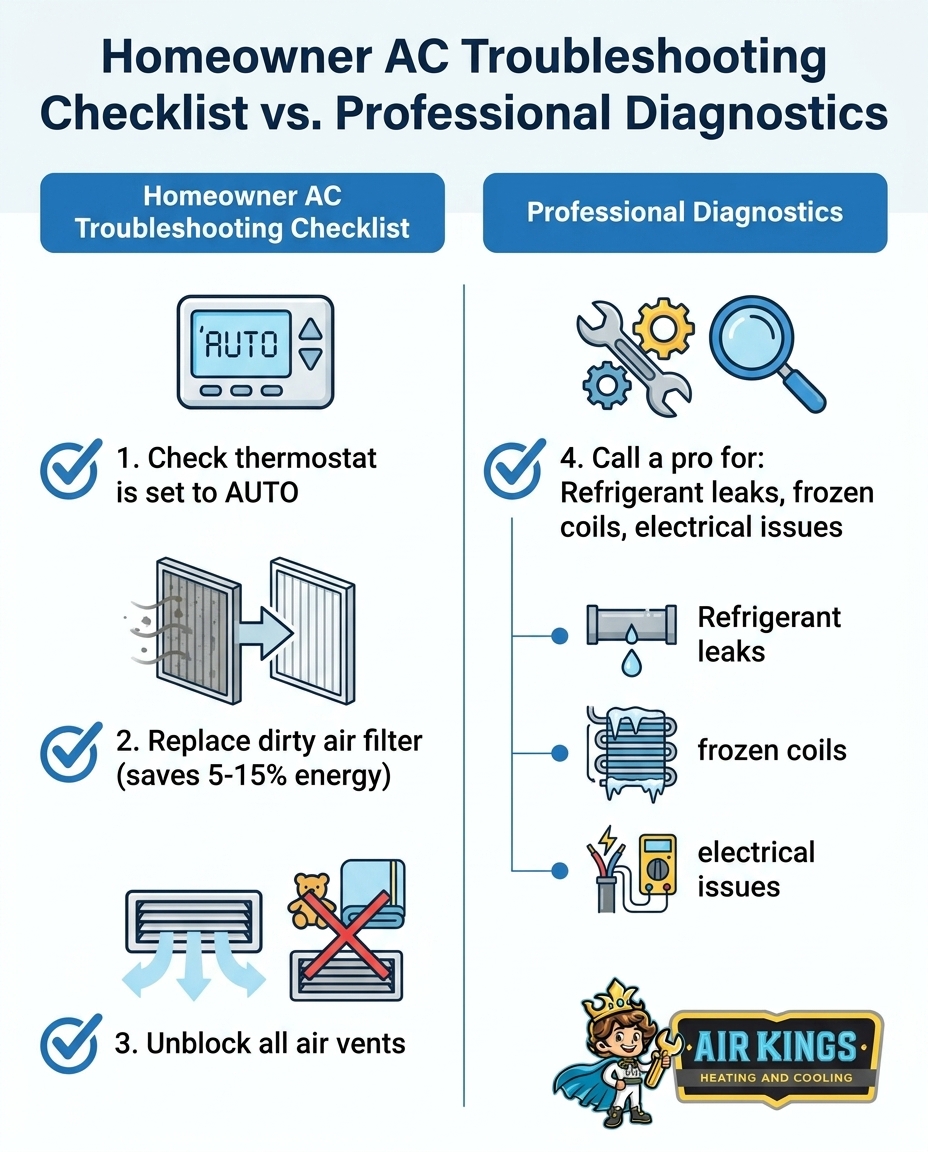
1. Verify your thermostat settings: Check the fan switch on your thermostat. It should be set to "AUTO" rather than "ON." When set to "ON," the blower fan will run continuously 24/7, even when the outdoor condenser is not actively cooling the air. Switching it to "AUTO" ensures the fan only runs during an actual cooling cycle.
2. Inspect and replace dirty air filters: A clogged air filter acts like a wall, blocking the return air your system desperately needs. Replacing a dirty, clogged filter with a clean one can lower your air conditioner's energy consumption by 5% to 15%. Check your filter monthly, especially during heavy usage periods.
3. Unblock all interior vents: Walk through your home and ensure that all supply registers and return grilles are fully open and unobstructed. Moving furniture, rugs, or heavy curtains away from the vents allows the system to "breathe" properly and distribute air evenly.
4. Check the outdoor condenser for debris: Ensure the outdoor unit is clear of tall grass, fallen branches, or heavy leaf buildup. The condenser needs at least two feet of clearance on all sides to effectively release the heat it pulls from your home.
A strict warning on DIY limits: Any steps beyond these basic airflow and thermostat checks require a licensed professional. Never attempt to open the electrical panel, test high-voltage components, or handle refrigerant lines yourself. These systems operate under high pressure and high voltage, posing severe safety risks if mishandled.
Mechanical Failures Behind End-of-Season AC Fatigue
If you have completed the safe troubleshooting steps and your system is still running constantly, you are likely dealing with a mechanical failure. The cumulative stress of the August 2026 late-summer humidity often pushes aging or unmaintained components past their breaking point. Here are the most common professional-level issues our team repairs during continuous operation calls.
Frozen Evaporator Coils
It sounds contradictory, but your air conditioner can actually get too cold. If severe airflow restrictions or refrigerant issues prevent warm indoor air from passing over the indoor evaporator coil, the condensation on the coil will freeze into a solid block of ice. Once the coil is encased in ice, it can no longer absorb heat from your home. The system will run continuously, blowing lukewarm air, as it desperately tries to satisfy the thermostat. This issue is similar to the causes behind a mini-split AC freezing up, requiring professional thawing and diagnosis.
Low Refrigerant Levels
Air conditioners do not consume refrigerant like a car consumes gas; it circulates in a closed loop. If your system is low on refrigerant, it means there is a leak. Slow leaks that have worsened over the summer reduce the system's ability to move heat from inside to outside. The unit will run non-stop to compensate for the missing refrigerant, eventually damaging the compressor if left unresolved.
Dirty Condenser Coils
The outdoor unit is responsible for releasing the heat absorbed from your home into the outside air. If the thin aluminum fins on the condenser coil are packed with dirt, pollen, and grass clippings, the heat remains trapped. The compressor has to work twice as hard and run twice as long to reject the heat. Just last August, our team rushed out to help a Mundelein family whose air conditioner crashed during extreme heat, causing the house to reach dangerous temperatures rapidly. Our technician arrived within hours and repaired the AC system the same day, proving how quickly a stressed system can fail when heat cannot escape.
Stressed Electrical Components
The intense heat of late summer is brutal on electrical parts. Capacitors, which provide the initial jolt of energy to start the motors, can bulge and fail under extreme temperatures. Contactors, the switches that send power to the compressor, can become pitted and stick in the "closed" position. When a contactor is stuck, the outdoor unit will run continuously, even if the indoor thermostat tells it to stop.
Recognizing When It Is Time for Professional AC Repair
Knowing when to stop troubleshooting and call an expert is crucial for protecting your investment. If your air filter is clean, your vents are open, and the thermostat is set correctly, but the unit still runs non-stop, professional diagnostics are required. Continuing to run a struggling system in the Mundelein and Chicagoland area will almost certainly turn a minor repair into a major, irreversible breakdown.
Listen and Feel for the Warning Signs
Pay close attention to the air coming from your vents. If the airflow feels weak or the air is noticeably warm, shut the system off immediately at the thermostat. Running an air conditioner with a frozen coil or a severe refrigerant leak will overwork the compressor until it burns out. Additionally, listen for unusual noises. A continuous, loud buzzing from the outdoor unit often indicates a failing electrical component, while a hissing sound near the indoor unit points to a refrigerant leak.
The Value of Rapid Expert Intervention
Fast, expert intervention is the key to resolving late-summer fatigue before it necessitates a complete system replacement. As a veteran-owned company, working with us means you're getting the same level of discipline and accountability that military service demands. We understand the specific toll the regional weather takes on HVAC systems and can intervene quickly. When a system goes down, time is of the essence. For example, our team recently helped a local customer whose central AC stopped working on a sweltering Friday afternoon, leaving them dreading a miserable weekend. One of our technicians came out Friday evening to diagnose the part issue, and returned Saturday morning to install the new component, completely restoring their comfort. We apply that same rapid response and dedication to our mini split systems and central AC repairs, ensuring you are never left waiting in the heat.
Frequently Asked Questions About Constant AC Operation
Why is my AC running but not cooling?
In our experience, when an air conditioner runs continuously without lowering the indoor temperature, it usually points to a frozen evaporator coil, a dirty condenser, or a refrigerant leak. The system is mechanically operating, but it has lost the ability to transfer heat effectively. Because these issues involve the sealed refrigerant loop or high-voltage components, resolving them requires professional diagnostic testing.
How long should an AC run on a hot day?
Under normal conditions, an air conditioner typically runs in 15 to 20-minute cycles. When the August 2026 late-summer humidity and extreme temperatures hit, the system works much harder to extract heat and moisture, which can extend cycles to 30 or 45 minutes. However, even on the hottest days, the unit should still eventually reach the thermostat set point and cycle off to rest.
Will a dirty filter cause my AC to run constantly?
Yes, a severely clogged air filter restricts the airflow entering the system, forcing the blower motor to work longer and harder to circulate cool air throughout the house. This lack of airflow can also cause the indoor coil to freeze, further extending the run time. Changing the filter is always the very first troubleshooting step you should take.
Should I turn off my AC if it keeps running?
If the air conditioner is blowing warm air, making loud grinding noises, or if you see ice forming on the copper refrigerant lines outside, you should turn it off immediately. Continuing to run a failing system places immense strain on the compressor. Shutting it down prevents severe, permanent damage while you wait for a technician to arrive.
When should I call for AC repair if it won't stop running?
You should call a professional immediately if basic airflow checks, like replacing the filter and opening vents, do not resolve the issue. Timely repair prevents minor late-summer fatigue from escalating into a major breakdown. Catching a stressed capacitor or a small refrigerant leak early can save the entire system from failure.
Restoring Comfort Before the Summer Ends
Ignoring a continuously running air conditioner during the end of the cooling season is a risk you cannot afford to take. The heavy workload placed on your system by the Mundelein and Chicagoland area weather means that minor issues will quickly snowball into major mechanical failures if left unchecked. Fortunately, a professional tune-up or targeted repair by our team can easily resolve late-summer fatigue, restoring your home's comfort and efficiency.
Taking action now ensures your equipment finishes the season strong and is ready for the years ahead. We encourage you to explore professional maintenance options to protect your system's longevity. By securing an AC maintenance plan, you can enjoy peace of mind knowing your system is thoroughly inspected, clean, and operating safely.

Customer
Testimonials

Great service Very professional
Air Kings was very friendly from start to finish. Very professional and on time. Always communicated with me to keep me informed. I highly recommend them.
Air Kings is a breath of fresh air when working with HVAC companies. Omar was incredibly helpful and polite, offering quality customer service I’ve never seen before. Very easy to talk with Air Kings, I recommend giving them a call!
Brian was super helpful and walked me through everything super nicely as well
Very satisfied
Great service Very professional
Air Kings was very friendly from start to finish. Very professional and on time. Always communicated with me to keep me informed. I highly recommend them.
Air Kings is a breath of fresh air when working with HVAC companies. Omar was incredibly helpful and polite, offering quality customer service I’ve never seen before. Very easy to talk with Air Kings, I recommend giving them a call!
Omar & team are great HVAC experts! They explain what they are doing and are always professional. Great techs that know what they are doing and reasonable prices.


Service areas